The short game – choosing the right clubs around the green as a beginner
Driving and approach shots can be challenging enough in golf, but it’s around the green where scores are really made. For golfers who become skilled in the short game, there are great opportunities to save strokes. Below, we’ll go through the basics of club selection to help you become more effective around the green.
Chipping – choose less loft for better control
Which clubs should you use for chips around the green?
- For a running chip – where the ball rolls for most of the distance between you and the hole – you can use anything from an 8-iron or pitching wedge to a 52-degree wedge.
- For shots that require more height, a 58- or 60-degree wedge is often the better option. These are typically used when there is an obstacle between you and the target.
When it comes to short chips and pitch shots, there are many different techniques to choose from. Much depends on the club you use.
Many golfers automatically reach for their highest-lofted club when playing from just off the green. If you master the technique, it can be an effective way to generate both height and spin, allowing the ball to stop close to the hole.
For beginners, however, it is often wiser to choose a club with less loft and allow the ball to roll for a greater portion of the distance. This type of shot generally reduces the margin for error, promotes more solid contact and makes distance control easier.
It is also worth mentioning a specialised club known as a chipper. It is designed specifically for these situations and allows you to use a putting-style stroke rather than a traditional chipping motion.

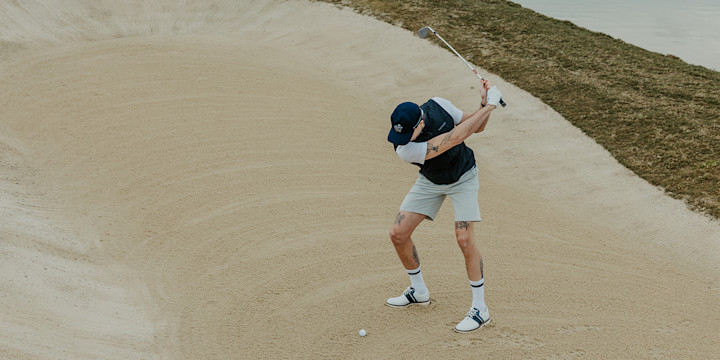
Bunker shots – a sand wedge goes a long way
Which club should you use for bunker shots?
In the bunker, it can be an advantage to use a wedge with plenty of bounce.
A traditional sand wedge usually has 54–56 degrees of loft, although many golfers prefer even more loft in bunker play. The key is to experiment and find what works best for you.
The more loft you have, the higher the ball flight. That said, 54–56 degrees is often more than enough, especially if you open the clubface slightly through impact. Doing so exposes more of the sole and bounce to the sand, helping the club glide through the surface rather than digging into it. The feeling is almost as if the sole of the club is skimming across the sand.
As a beginner, it is important not to expect too much from yourself. Your primary goal should be to get the ball out of the bunker with one shot, giving yourself a chance to play the next shot from the grass. Avoid taking unnecessary risks by attempting overly difficult shots. For longer bunker shots (more than 20 metres), using a pitching wedge can also be a smart option.
Putting – choose something that feels stable
When it comes to putting, there are no real right or wrong answers – the most important thing is finding a putter that inspires confidence and feels comfortable in your hands.
In the past, most golfers used blade putters simply because that was what was available. Today, so-called mallet putters are far more common. A mallet putter has a larger clubhead, making it more stable and forgiving on strikes that are not hit from the centre of the face.
Blade putters, on the other hand, often offer advantages when it comes to feel and distance control.
In recent years, so-called zero-torque putters have also become increasingly popular. These putters feature a more centred weight distribution and are designed to keep the clubhead stable throughout the putting stroke, helping the ball start on a straighter line.
Whatever you choose, it is always worth trying a variety of models to find the putter that suits you best.